



When someone describes a diamond as “sparkling,” they’re reacting to something very specific that goes beyond measurements and grading scales. What they’re really seeing is how the diamond interacts with light.
This is what defines Visual Performance. At its core, Visual Performance is a way of understanding how a diamond actually looks, not just how it’s graded on paper. It reflects the combined effect of brilliance, fire, contrast, and overall face-up beauty, which are the qualities your eye notices instantly, even if you can’t quite explain why.
Visual Performance is the result of several elements working together. Brilliance refers to the return of white light, creating overall brightness, while fire describes the dispersion of light into flashes of color. Contrast is the balance of light and dark areas that gives a diamond depth and pattern.
Together, these elements create a dynamic, ever-changing appearance that makes a diamond feel alive, shifting and responding as it moves through different lighting and angles. At VeraLume, these qualities are not treated as abstract ideas but are evaluated as measurable aspects of how a diamond performs visually, creating a more complete picture of its beauty.
Traditional grading systems rely on factors like proportions, symmetry, and polish to predict how a diamond should perform. While these characteristics are important, they are still approximations. Two diamonds with similar grades can look noticeably different in real life, as subtle variations in facet precision, internal structure, or light behavior can change how a diamond reflects and disperses light.
This gap between what is measured and what is actually seen is where Visual Performance becomes essential. Ultimately, a diamond is not experienced as a set of specifications, but through how it appears to the eye.
Visual Performance at VeraLume goes beyond traditional grading by incorporating additional factors that directly influence how a diamond appears.
Even within colorless grades, subtle undertones—like brown, gray, or blue—can affect how bright or crisp a diamond looks. These nuances are often overlooked in standard reports but can noticeably influence overall appearance

Formed during the lab-growing process, internal growth features can impact transparency and how light travels through the stone. More visible growth lines can reduce brilliance or create a softer appearance.
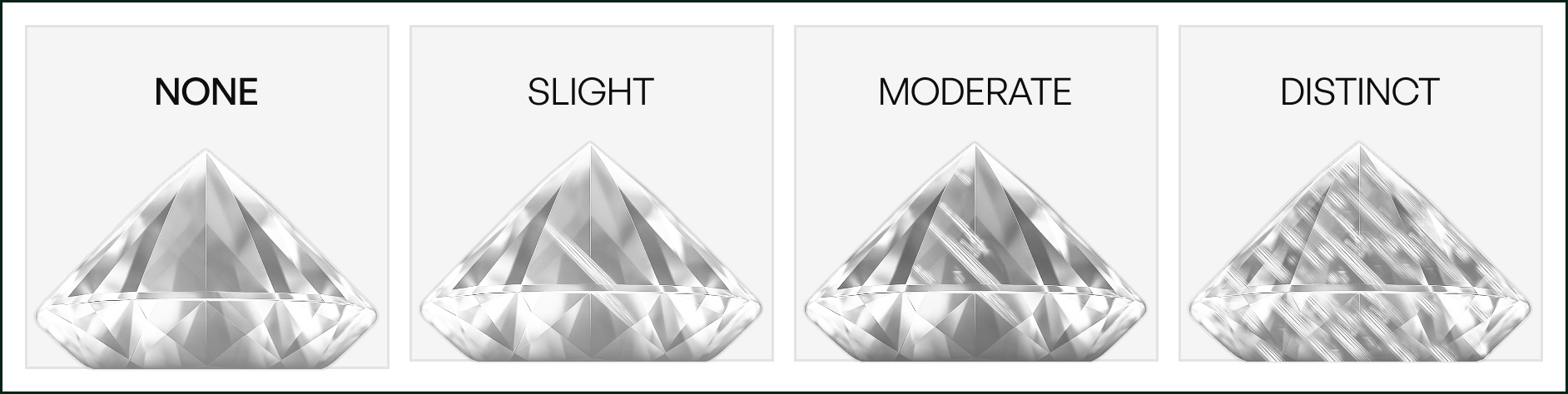
Beyond traditional clarity grading, structural characteristics are considered for how they affect light return and visual purity.
Together, these factors help explain why two diamonds that look similar “on paper” can perform very differently face-up.
To make Visual Performance more clear and comparable, VeraLume assigns each diamond a Visual Performance Score. This score reflects how well a diamond handles light based on a combination of measurable factors and real-world appearance.
Rather than relying on a single characteristic, the score brings together multiple elements of performance into one simplified scale, making it easier to understand how a diamond will actually look.
The scale is broken down into five categories:

Diamonds that fall within the higher ranges demonstrate strong brightness, balanced contrast, and vibrant fire, while lower ranges may show more light leakage, reduced brilliance, or less consistent visual patterning.
By translating complex performance data into a clear, digestible score, VeraLume makes it easier to compare diamonds based on what truly matters: how they appear to the eye.
The Visual Performance Score is designed to capture the key visual qualities that influence how a diamond appears face-up. Rather than focusing on a single factor, it reflects how multiple elements come together to shape the overall look of the stone.
This includes:
By evaluating these qualities together, the score provides a clearer view of how a diamond will present visually at a glance.
To evaluate Visual Performance more directly, VeraLume analyzes how light behaves within the diamond, rather than relying only on how it is expected to perform.
This includes:
Additional indicators, such as Hearts & Arrows patterns in round diamonds, can confirm precise facet alignment and further support strong visual performance.
This approach connects measurable characteristics to what is ultimately seen, creating a more complete understanding of how a diamond performs.
One of the most important outcomes of Visual Performance is something simple: how the diamond looks when viewed from the top. This is often referred to as face-up beauty, or the immediate impression created by brightness, balance, and symmetry.
This is often referred to as face-up beauty—the immediate impression created by brightness, balance, and symmetry.
It includes:
It’s the moment when someone sees a diamond and instantly recognizes that it looks exceptional, even before they know anything about its grading.
Visual Performance bridges the gap between technical grading and real-world appearance. Traditional grading explains what a diamond is, while Visual Performance reveals how it actually looks.
By combining light behavior, structural characteristics, and advanced grading factors, it offers a more complete and transparent understanding of a diamond’s beauty, especially in lab-grown stones where subtle differences in growth and structure can have a meaningful impact.
The purpose of a diamond isn’t to meet a theoretical standard, but to look exceptional every time it’s seen. Visual Performance brings the focus back to what truly matters: how a diamond appears in real life, across different lighting, angles, and moments.
By prioritizing how a diamond actually looks rather than how it is predicted to perform, Visual Performance ensures that what you see aligns with what you expect. The result is a diamond that not only grades well, but consistently stands out the moment you look at it.


